


Driving the Future: A Comprehensive Guide to the Innovations of Ford Motor Co
What is Ford Motor Co’s impact on the automotive industry today? From pioneering the assembly line to embracing electric vehicles, Ford Motor Co has sustained its reputation for innovation. This article examines Ford Motor Co’s latest advancements, market influence, and commitment to sustainability—key factors behind why it remains a significant player in the auto sector.
Key Takeaways
- Ford Motor Company, founded by Henry Ford in 1903, introduced revolutionary manufacturing with the assembly line, establishing the Model T as an iconic vehicle and setting the stage for accessible mobility.
- The Ford brand has evolved through the Model T, Mustang, and the best-selling F-Series trucks, highlighting a tradition of innovation and market dominance with current success like the F-150 winning the Kelley Blue Book Best Buy award.
- Ford continues to lead with advancements like EcoBoost engines, electrification efforts like the F-150 Lightning, hands-free BlueCruise technology, and is committed to sustainability with aspirations for carbon neutrality by 2050.
The Visionary Beginnings

Photo Courtesy of ford Corporate
Henry Ford, who had a lifelong fascination with mechanics from an early age, founded the Ford Motor Company in 1903 with a bold vision. His aim was to profoundly change how automobile ownership was perceived and make it more accessible for everyone globally. The company’s mission statement “TO DO MORE FOR THE WORLD THAN THE WORLD DOES FOR YOU” served not only as their guiding principle but also as an embodiment of Henry Ford’s ambition to democratize mobility.
Having been born on July 30, 1863, in Springwells Township, Michigan, Henry Ford’s zeal for mechanics manifested itself early on. By the tender age of just fifteen years old, he successfully built his first steam engine—a clear indication of his mechanical prowess that would later define both his life and create lasting impact through the establishment of one of the world’s most iconic automobile companies.
The Quadricycle
Henry Ford made his foray into the realm of motor vehicles with the introduction of the Quadricycle, an early off-road prototype that paved the way for modern automobile technology. Constructed in 1896, this pioneering creation boasted metallic parts, a basic system to manage engine heat and sturdy wheel construction—elements that demonstrated what personal transportation could become.
Ford’s colleagues and friends were quick to grasp the importance of his innovative work. They wasted no time establishing a network of dealerships which would lay down an essential foundation for what would evolve into Ford’s sprawling empire centered on trucks. The humble Quadricycle thus transformed from merely being an ingenious contraption to serving as tangible proof of Henry Ford’s ingenuity and forward-thinking approach in mechanical design.
Mass Production and the Assembly Line
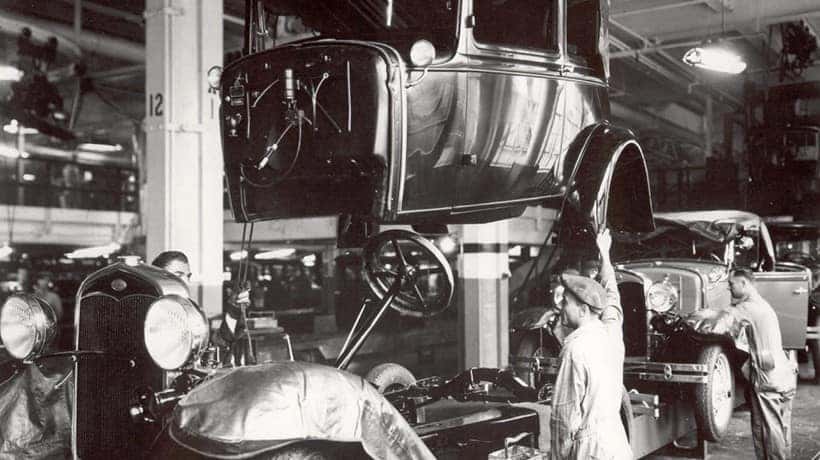
Photo Courtesy of Ford Corporate.
The automotive industry was radically revolutionized when Ford unveiled the moving assembly line and methods for mass production. These groundbreaking techniques optimized manufacturing, enabling individuals from diverse socioeconomic backgrounds to possess an automobile. Launched in 1908, the Model T became emblematic of this modern era of manufacturing, facilitating scale and affordability at levels never before seen by Ford.
Ford’s implementation of the assembly line didn’t merely alter vehicle production practices. It also bolstered his workforce. This shift engendered a novel economic model that had wide-reaching implications worldwide while simultaneously enhancing efficiency in loading procedures.
The Evolution of Ford Vehicles

A.I. Illustration of the evolution of Ford vehicles.
Throughout the years, Ford Motor Company has undergone substantial transformation and growth, leaving an indelible mark on both its own brand narrative and the broader car industry. The evolution from their initial ‘script with wings’ emblem to the adoption of the famous blue oval has allowed Ford to consistently reinvent itself while maintaining a heritage of superior quality across all vehicles.
In 1976, when Ford transitioned to using the blue and silver oval logo, it signified more than just an aesthetic alteration—it ushered in a new era for universal branding within the company that came to be associated with dependability and groundbreaking development throughout their product range. This rebranding encompassed everything from their renowned trucks right through to cutting-edge models set for release in 2024, demonstrating Ford’s ongoing commitment to innovation.
Model T: The Car that Changed the World
The ‘Tin Lizzie,’ or the Model T, was more than a mere automobile. It became an emblem of change for society’s way of living. Henry Ford had a precise goal with the Model T: to manufacture a vehicle that was not only affordable but also simple and robust enough to revolutionize life across our planet. The result? More than 15 million units sold worldwide, extending its influence well beyond America’s borders and shaping societies everywhere.
Contrary to common misconceptions, early versions of the Model T were available in various colors before Ford Motor Company adopted the standard black color scheme for efficiency purposes. This storied car has left an indelible mark on history due to both Ford’s forward-looking vision and his company’s long-standing heritage within the world of automobiles.
Mustang: A Legend is Born
The Ford Mustang remains an iconic presence in the narrative of American muscle cars, a true testament to its storied past. Ever since it first roared onto the scene, this vehicle has enchanted motoring enthusiasts with its intoxicating blend of raw power and alluring design—all while symbolizing unbridled freedom. For more than sixty years, those eager to make their mark on highways have consistently chosen the Mustang.
With each passing year, innovation is woven into the fabric of Mustang’s history as it evolves to meet modern demands without sacrificing its quintessential essence. As we anticipate what’s in store for 2024 with Ford’s offerings, we are reminded by the enduring legacy of the Mustang just how adept Ford is at creating automobiles that profoundly connect with our very souls.
F-Series Trucks: America’s Best-Selling Trucks
The F-Series trucks, renowned for their superior performance and adaptability, have consistently been the top-selling trucks in America for an impressive 47 years. The 2024 Ford F-150 epitomizes this legacy of excellence by being recently awarded with the Kelley Blue Book Best Buy award.
Engineered to simplify even the toughest jobs, the robust lineup that includes the acclaimed F-150 combines both strength and opulence ideally suited for work or recreation. With options such as potent off-road packages and an array of powertrain selections, Ford’s dedication shines through in its commitment to delivering vehicles like the F-Series that not only fulfill but surpass customer expectations.
Pioneering Innovations
Ford’s enduring achievement in the automotive sector can be attributed to its commitment to innovation and forward-thinking. This visionary mindset has spawned technological breakthroughs that have transformed expectations of automobile capabilities, including developments such as EcoBoost engines, vehicle electrification, and hands-free driving innovations like BlueCruise – all testament to Ford’s relentless pursuit of engineering excellence.
Looking toward what lies ahead, Ford leverages the formidable force of artificial intelligence and machine learning not merely for refining vehicle architecture but also for overhauling how consumers interact with their vehicles. This ensures that Ford cars remain a seamless blend of intellect and strength.
EcoBoost Engines
Ford’s EcoBoost engine represents a significant advancement in the realm of powertrain options, utilizing cutting-edge technology. This innovation marries turbocharging with direct fuel injection and variable camshaft timing to achieve superior fuel efficiency while maintaining robust power levels. This powerful option is available for an array of Ford models including the sturdy F-150 and the daring Bronco Sport, providing a spectrum of power outputs designed to meet varying driver demands without sacrificing emissions standards.
Not only does EcoBoost technology underscore Ford’s commitment to pioneering new technologies, but it also aligns with their broader objective toward electrification and sustainable transportation solutions.
Electrification and the Future of Mobility
Ford is at the leading edge of transitioning to electrified transportation, committing itself to a future where mobility means carbon neutrality. Their lineup encompasses vehicles powered by gas, as well as hybrid and fully electric models such as the dynamic all-electric F-150 Lightning which boasts impressive torque and cutting-edge capabilities.
The Mustang Mach-E joins the F-150 Lightning in blazing trails for Ford’s electric vehicle offerings with state-of-the-art features like Ford Co-Pilot360 – thanks to a diverse tech team that includes key women contributors. Despite its shift towards sustainable energy sources, Ford continues unwaveringly to offer powerhouses known for their performance even while it ushers in this new era marked by efficient and environmentally friendly electric automobiles.
BlueCruise Hands-Free Driving
Ford has unveiled BlueCruise technology, a step towards the future of autonomous driving, designed to provide drivers with hands-free operation on highways that support this feature. The system permits the enjoyment of autonomous navigation while maintaining driver control and is constantly updated through over-the-air software enhancements, thereby keeping your Ford vehicle at the forefront without requiring you to go to a dealership.
Embracing an era where travel transcends mere point-to-point journeys and embraces the experience en route, BlueCruise epitomizes Ford’s dedication to liberty and technological advancement. For additional information on how Ford is redefining driving freedom, please visit our website at www.
The Ford Family Legacy
The influence of the Ford family on the trajectory of their nameake company is profoundly noteworthy. When Henry Ford stepped down in 1945, his grandson, Henry Ford II, took over and upheld the tradition of innovation and leadership within the car industry that had become synonymous with their name. In modern times, they still play a crucial role in steering corporate affairs due to a unique category of stocks that preserve their sway.
Representing this enduring heritage is William Clay Ford Jr., who serves as executive chairman. As Henry Ford’s great-grandson, he also stands out as the corporation’s most significant individual stockholder—with ownership amounting to a 23% share by 2022. The dedication shown by the Fords toward fostering prosperity for their business has played an indispensable part in ensuring its position at the forefront of automobile industries worldwide throughout all these years.
Ford’s Commitment to Sustainability
Ford regards sustainability as more than a fleeting trend—it’s an essential tenet that influences their strategic decisions and future goals. For over two decades, Ford has openly communicated its progress on the path to sustainability by releasing its annual Integrated Report for 25 years, underscoring its transparency in this long-standing journey. The company’s goal is not just ambitious but also clear-cut: reach carbon neutrality across global operations by 2050 and accelerate this target in Europe with a deadline of 2035.
The scope of Ford’s commitment encapsulates much more than merely cutting down vehicle emissions. It includes every aspect of their business practices, from employing sustainable materials to conserving water and ethically procuring raw materials. By aiming for the utilization of solely carbon-free electricity within its manufacturing processes and promoting broader adoption of renewable energy sources, Ford showcases a comprehensive strategy towards sustainability—a principle deeply ingrained in the corporate philosophy.
The Global Impact of Ford Motor Company
Globally, the influence of Ford Motor Company is palpable, manifesting in significant GDP contributions, employment opportunities and enhancements to community well-being. With an injection of about $99.7 billion into economies worldwide, Ford sustains over a million individuals’ livelihoods with approximately 124,000 employees based in the United States alone. As Louisville’s top manufacturing employer demonstrates, one company can dramatically alter a local financial landscape.
Ford extends its impact beyond mere economic metrics. It actively enriches communities through endeavors such as the Bronco Wild Fund. This initiative has championed conservation efforts throughout 44 states—underscoring Ford’s unwavering commitment to fostering environmental stewardship and positive change within communities it serves.
Summary
From its inception with the Quadricycle to modern-day breakthroughs, Ford Motor Company’s history is marked by continuous advancement and a dedicated pursuit of greatness. The imprint of Henry Ford, the progression within their range of vehicles, trailblazing technological developments, and the widespread influence from their global operations are integral components woven into the intricate narrative of Ford’s chronicle. Looking forward, Ford is destined to remain an influential force in shaping the contours of vehicular innovation while promoting sustainable and equitable transportation solutions for all. The horizon brims with opportunities where Ford stands ready as a leader. It’s visionary ethos and unwavering resolve set to steer us down this future path.
Frequently Asked Questions
When was Ford Motor Company founded, and who was the founder?
In 1903, Henry Ford established the Ford Motor Company with a mission to make owning an automobile both affordable and feasible for the general population.
What was the significance of the Model T in automotive history?
The automobile sector was transformed by the Model T, which made owning a car possible for many people and brought forth major advancements that defined automotive production in years to come. It played an instrumental part in reshaping both transportation and manufacturing industries.
How has the Ford family influenced the company over the years?
The influence of the Ford family on company decisions has been considerable, thanks to a unique category of shares they hold. Prominent individuals such as William Clay Ford Jr. persist in sustaining the heritage.
Their contribution to the enterprise is noteworthy and significant.
What is Ford’s commitment to sustainability?
Ford has pledged to attain global carbon neutrality by the year 2050, with a more immediate goal set for Europe by 2035. In pursuit of this commitment, they have introduced initiatives geared towards sustainable manufacturing, one of which is the shift toward using completely carbon-free electricity in their production processes.
Their actions underscore a strong dedication to embracing sustainability practices within their operations.
What is BlueCruise technology, and how does it contribute to the future of driving?
The BlueCruise technology offers the luxury of autonomous driving with its capability for hands-free operation on designated highways. It maintains its cutting-edge status by incorporating over-the-air updates to continually enhance the system.
Such technology is poised to have a profound impact on the evolution of how we drive in times to come.

0 comment(s) so far on Driving the Future: A Comprehensive Guide to the Innovations of Ford Motor Co