


F-150 vs Tundra: Which Full-Size Truck Fits Your Work?
Wareing Sturgis Ford
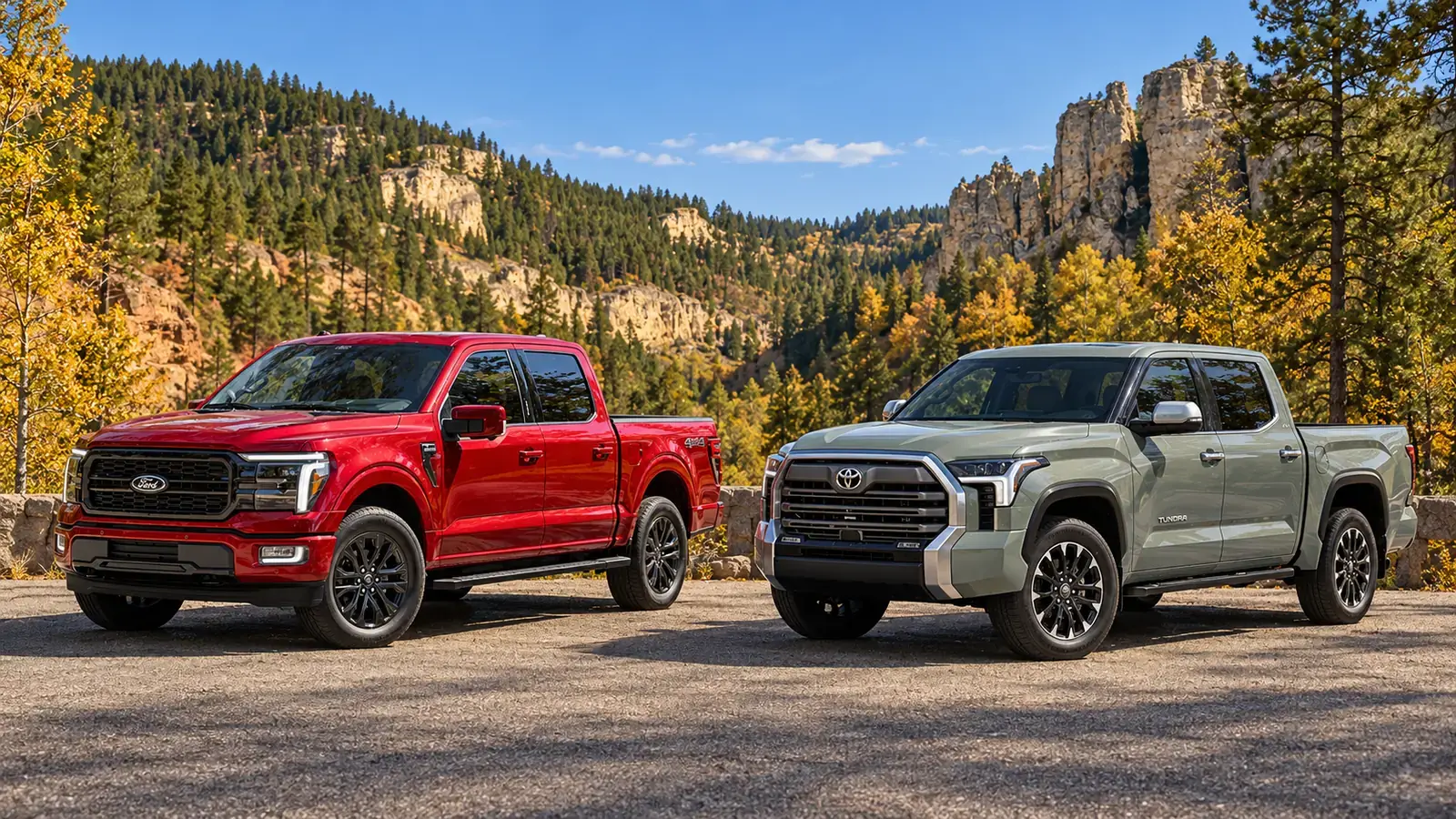
A side-by-side look at the 2026 Ford F-150 and 2026 Toyota Tundra using Ford, Toyota, and EPA figures.
The F-150 vs Tundra question shows up when you want a full-size truck and you are weighing Ford’s capability ceiling against Toyota’s twin-turbo V6 and hybrid story. Both haul people, trailers, and weekend gear. They spend their engineering budgets in different places.
Ford lists higher maximum available towing and payload on the F-150 when you pick the right engine and packages. Toyota lists a twin-turbo i-FORCE V6, an i-FORCE MAX hybrid, multi-link coil rear suspension, and a composite bed. Peak brochure numbers still sit under the door label on the truck you buy.
The figures on this page come from ford.com, toyota.com, Toyota’s 2026 Tundra pressroom release, and the EPA’s fueleconomy.gov, checked October 26, 2026. Equipment changes by cab, bed, axle, and package. Confirm the window sticker and door label on the truck you are looking at.
F-150 vs Tundra at a glance
| Shopping point | 2026 Ford F-150 | 2026 Toyota Tundra |
|---|---|---|
| Max available towing | 13,500 lbs when properly equipped | 12,000 lbs when properly equipped |
| Max available payload | 2,440 lbs when properly equipped | 1,850 lbs (toyota.com capability teaser) |
| Standout powertrains | 3.5L EcoBoost max-tow path. PowerBoost hybrid with available Pro Power Onboard up to 7.2 kW | i-FORCE twin-turbo V6. i-FORCE MAX hybrid |
| EPA combined examples (4WD) | PowerBoost 23. 2.7L EcoBoost 20. 3.5L EcoBoost 19. 5.0L V8 19 | Gas 19. Hybrid 20. Hybrid PRO 19 |
| Ride focus (OEM claims) | Work capability, available tow tech, trim-specific off-road hardware | Multi-link coil rear suspension and composite bed |
| Starting MSRP (OEM) | Confirm Ford Build & Price for the cab and drive you want | From $41,260 (SR). Capstone $80,800 |
MSRP excludes destination, taxes, and dealer fees. Towing and payload apply when properly equipped. EPA figures are estimates from fueleconomy.gov for listed configurations. Toyota payload figure follows the live toyota.com capability teaser checked October 26, 2026. Read the door label on the VIN you buy.
Lean F-150 if
You want the higher published max tow and payload ceilings, available Pro Power Onboard, or you already service Fords in Sturgis.
Lean Tundra if
You want Toyota’s twin-turbo hybrid path, coil rear suspension story, and composite bed, and you shop Toyota service separately.
Engines and performance
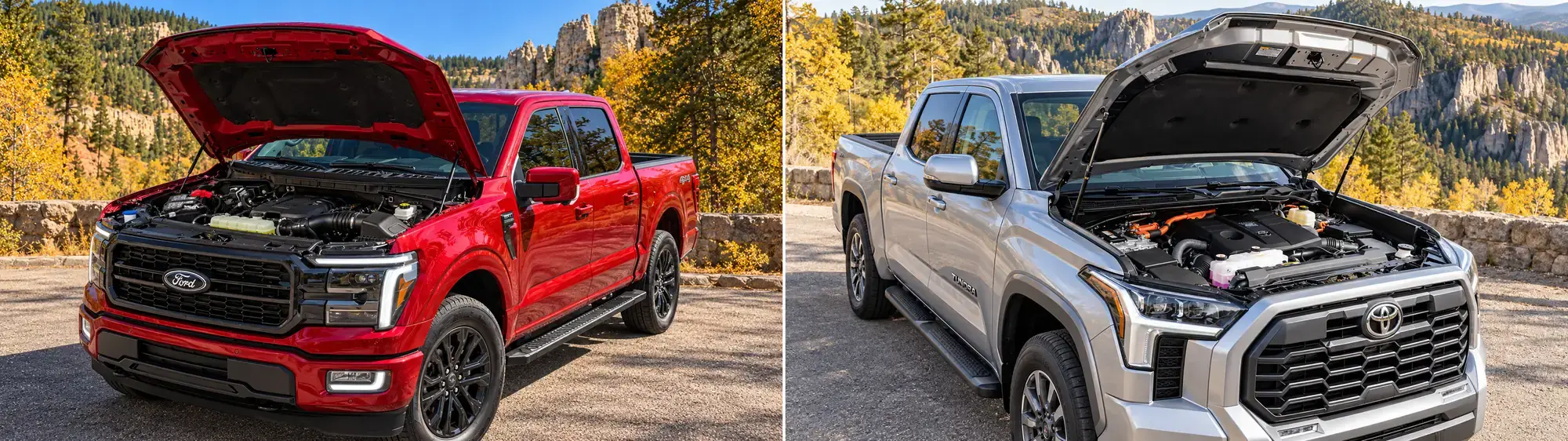
Ford.com lists a turbo 2.7L EcoBoost at 325 horsepower and 400 lb-ft of torque, a turbo 3.5L EcoBoost at 400 horsepower and 500 lb-ft, a 5.0L V8 at 400 horsepower and 410 lb-ft, and a 3.5L PowerBoost full hybrid at 430 horsepower and 578 lb-ft. Raptor models add high-output options that serve a different mission than a work truck. PowerBoost horsepower, torque, and towing here follow the live ford.com F-150 pages. Older Ford towing-guide PDFs can list different figures. Use ford.com and the door sticker for the truck you buy.
Toyota and the July 22, 2025 Toyota pressroom release list the twin-turbo 3.4L i-FORCE V6 at 389 horsepower and 479 lb-ft, and the i-FORCE MAX hybrid at 437 horsepower and 583 lb-ft. Both feed a 10-speed automatic. Confirm the rating on the window sticker for the grade you want.
Horsepower alone does not pick the truck. The PowerBoost path trades some max tow for hybrid assist and available Pro Power Onboard generator output up to 7.2 kW. Toyota’s jobsite callout highlights a 120V/400W AC outlet. Match the engine to the trailer and the tools you plug in, not to the largest number on a brochure.
Towing and payload
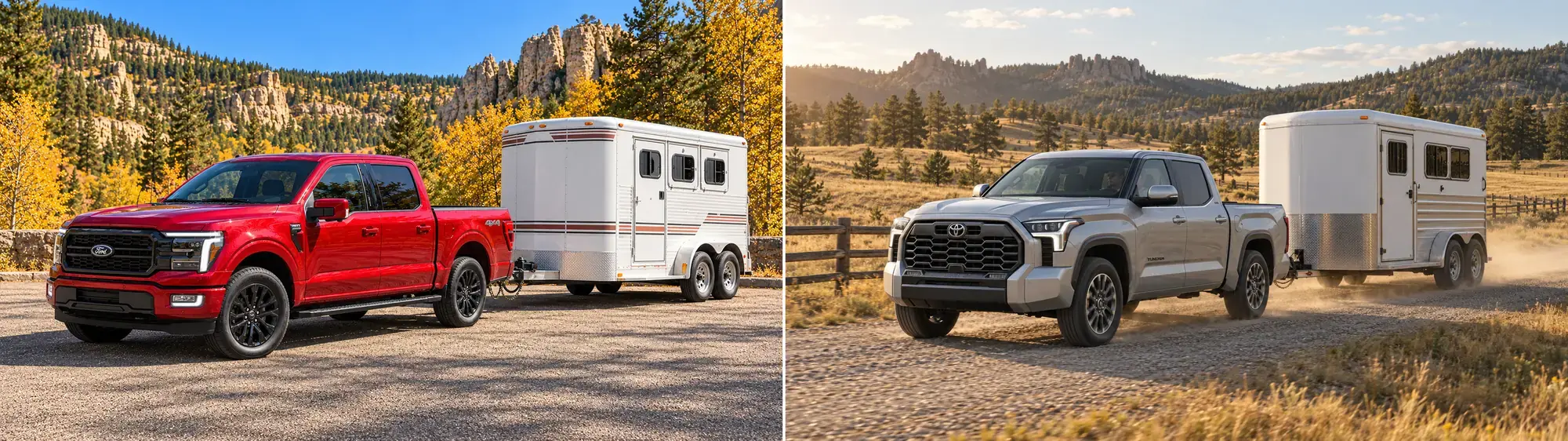
If your shortlist starts with trailer weight, start here. Ford lists up to 13,500 pounds of max available conventional towing on the 2026 F-150 when properly equipped. Toyota lists up to 12,000 pounds on the 2026 Tundra when properly equipped.
Ford’s published engine ceilings on ford.com are 8,400 pounds for the 2.7L EcoBoost, 11,600 pounds for the PowerBoost hybrid, 12,800 pounds for the 5.0L V8, and 13,500 pounds for the 3.5L EcoBoost. The max-tow path needs the packages Ford calls out for that build.
Payload is the other half of the story. Ford lists up to 2,440 pounds of payload capacity. Toyota’s live site teaser lists up to 1,850 pounds. People, fuel, hitch hardware, bed cargo, and tongue weight all count against that number. Crew cab 4×4 trucks with big wheels sit well under the headline. Match towing capacity and payload capacity to the door label on the model you will buy, not only the brochure peak.
Trailering tech varies by trim and package. Ford promotes available tow aids and Pro Trailer Hitch Assist language on its truck pages. Toyota promotes Tow Hitch Assist and trailering features by grade. Confirm camera views, blind-spot coverage with a trailer, and hitch hardware on the sticker before you assume a feature is included.
Fuel economy and hybrid options
Half-ton MPG depends on engine and drivetrain more than the badge. The EPA rates a 2026 F-150 4WD PowerBoost hybrid at 22 city, 24 highway, and 23 combined. A 2026 F-150 4WD 2.7L EcoBoost is 18/23/20. A 4WD 3.5L EcoBoost is 17/23/19. A 4WD 5.0L V8 is 16/24/19.
On the Tundra side, fueleconomy.gov lists a 2026 Tundra 4WD gas configuration at 17 city, 22 highway, and 19 combined. A 2026 Tundra Hybrid 4WD is 19/22/20. A Hybrid 4WD PRO configuration is 18/20/19. Those are EPA estimates for listed configurations. Your real-world number changes with trailer weight, tires, and speed.
Hybrid shoppers should compare jobs, not badges. PowerBoost pairs hybrid assist with available Pro Power Onboard up to 7.2 kW for tools away from an outlet. i-FORCE MAX leads Toyota’s horsepower and torque chart for the Tundra and still sits under Toyota’s 12,000-pound max tow when properly equipped. Plug-in tools and trailer weight decide the better hybrid for you.
Cab, bed, and size options
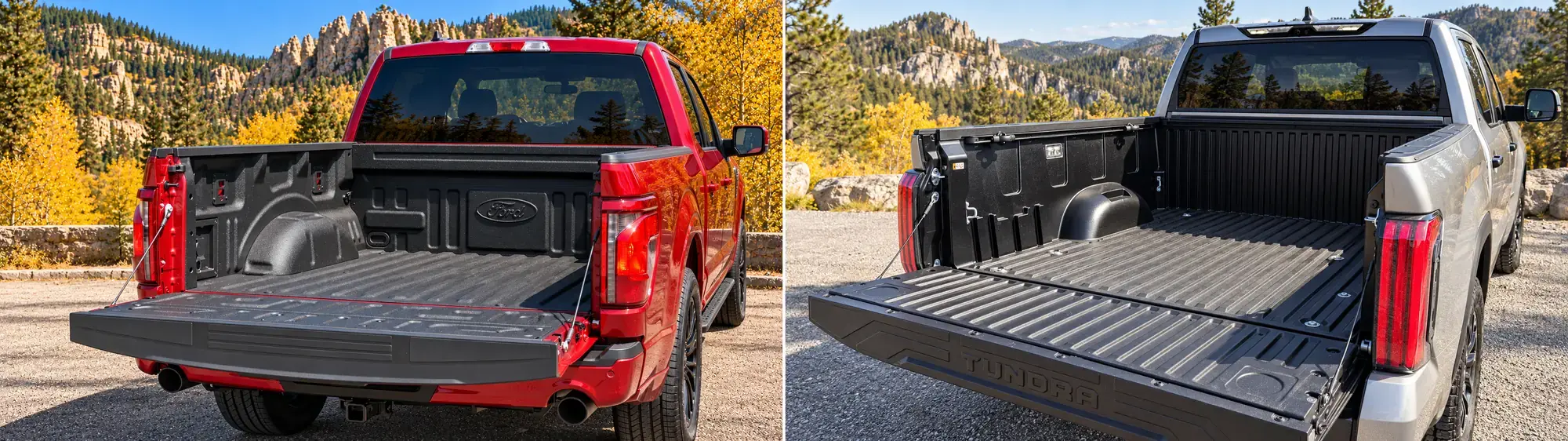
Ford offers Regular Cab, SuperCab, and SuperCrew with bed lengths that commonly include 5.5-foot, 6.5-foot, and 8-foot boxes depending on cab. Toyota’s current Tundra lineup centers on Double Cab and CrewMax with composite bed lengths Toyota lists around 5.5, 6.5, and 8.1 feet by configuration.
Bed features matter as much as length. Ford promotes available Pro Access Tailgate and work lighting on its truck pages. Toyota promotes a composite bed that does not need a spray-in liner for many buyers. Measure garage depth and gate clearances before you lock a long bed. A CrewMax with an 8.1-foot bed and a SuperCrew with an 8-foot bed both ask for driveway space you may not have.
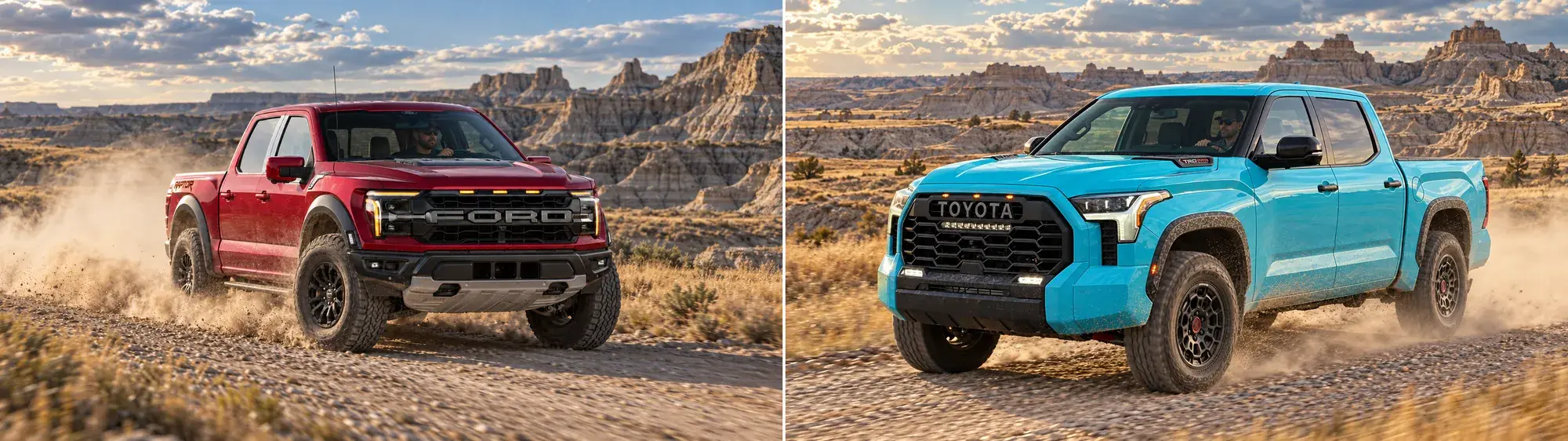
Ride quality, suspension, and off-road
Shoppers who cross-shop these two trucks often talk about empty-bed ride on the highway. Toyota promotes a multi-link coil-spring rear suspension on the Tundra. Ford spends more of the F-150 story on capability packages, available BlueCruise hands-free highway driving on select trims, and trim-specific off-road hardware such as Tremor and Raptor.
Off-road trims are not interchangeable with work trims. Ford’s Tremor and Raptor packages target trail and high-speed desert use with hardware that can change payload and fuel economy. Toyota’s TRD Off-Road and TRD Pro packages add locking differentials, skid plates, and suspension changes by grade. The useful test around Sturgis is a loaded and empty drive on the roads you use every week, including I-90 and gravel.
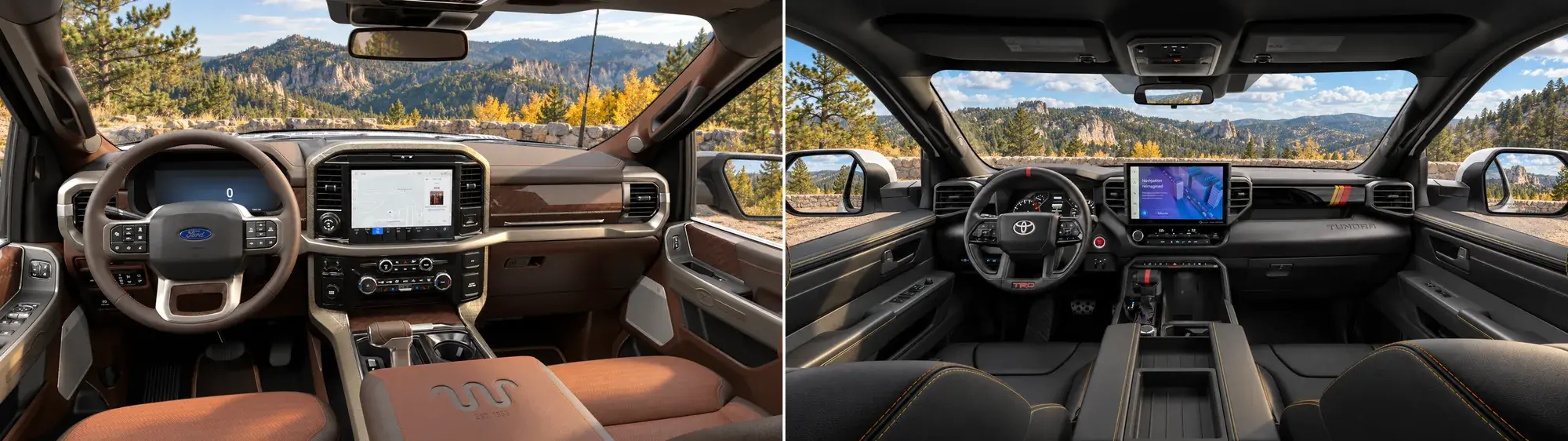
Interior, tech, and safety suites
Ford counters work-focused options such as available Interior Work Surface, zone lighting, and Pro Power Onboard with SYNC 4 screens that grow by trim. Toyota markets upper grades around materials, available panoramic roof language, and Toyota Audio Multimedia. Sit in both. Check rear-seat room with the people who ride with you.
Safety suites vary by model year and trim. Ford groups many driver-assist features under Co-Pilot360, with available BlueCruise on select F-150 trims. Toyota groups many features under Toyota Safety Sense. We do not invent NHTSA or IIHS scores here. Look up the exact configuration at NHTSA.gov and IIHS.org, and confirm which driver-assist features appear on the window sticker.
Warranty, maintenance plans, insurance, and resale change with trim, mileage, and how you use the truck. Compare the written warranty booklet for the VIN you buy. We do not invent reliability rankings or depreciation percentages on this page.
Price and trims
Toyota lists 2026 Tundra MSRP from $41,260 for SR through $80,800 for Capstone on toyota.com. Grades commonly include SR, SR5, Limited, Platinum, 1794 Edition, TRD Pro, and Capstone. Those figures exclude destination, taxes, and dealer fees.
Ford F-150 trims commonly include XL, STX, XLT, Lariat, King Ranch, Platinum, Tremor, and Raptor. Base MSRP moves with cab, bed, and drive type. Confirm current Ford Build & Price and the window sticker when you compare a loaded model. We do not list monthly payments here. Offers change. For current paths on a Ford, talk with our finance team. Our 2026 F-150 trim guide walks through XL through Raptor in plain language.
Which truck fits the work?
Pick the F-150 if
You want the higher published max tow and payload ceilings, the PowerBoost hybrid with available generator power, or you already service Fords in Sturgis. Parts and the service lane stay in one building at 1 Ford Place.
The Tundra makes sense if
Toyota’s twin-turbo hybrid path, coil rear suspension, and composite bed sit higher on your list than the last pound of published towing, and you are ready to service the truck at a Toyota dealer.
Still weighing Ram or Chevy in the mix? Our F-150 vs Ram 1500 comparison and F-150 vs Silverado 1500 comparison cover those half-ton forks with the same OEM-first approach.
See the F-150 in Sturgis
Wareing Sturgis Ford is at 1 Ford Place, Sturgis, SD 57785. Call sales at 605-702-0460. Main line 605-347-3662. Browse new F-150 inventory, check trade-in value, or talk through payments in the finance center.
Bring trailer weight, passenger count, and how far you tow. We will map that to a live F-150 instead of a chart row.
F-150 vs Tundra FAQ
Which truck tows more, the F-150 or the Tundra?
Ford lists up to 13,500 pounds of max available conventional towing on the 2026 F-150 when properly equipped. Toyota lists up to 12,000 pounds on the 2026 Tundra when properly equipped. Your truck will be lower unless it is the max-tow build. Read the door label for the VIN you buy.
Is the Tundra more reliable than the F-150?
There is no honest brand-wide answer for every configuration. Engine choice, maintenance, duty cycle, rust, and repair history matter. For a new truck, compare warranty coverage and the service department you expect to use. Look up recalls for the exact vehicle by VIN at NHTSA.gov.
Which truck gets better gas mileage?
It depends on the engine. On fueleconomy.gov, a 2026 F-150 4WD PowerBoost hybrid is 22/24/23 city/highway/combined. A 2026 Tundra Hybrid 4WD is 19/22/20. Gas engines on both trucks commonly land in the high teens for combined MPG in 4WD form. Compare the EPA label on the trucks you can actually buy.
Does the Tundra or F-150 have better resale value?
Resale depends on mileage, condition, options, and the used market when you sell. We do not invent depreciation percentages here. Compare recent sold comps for the cab, engine, and trim you want, and factor in how long you plan to keep the truck.
Which truck is safer?
Safety depends on the exact configuration and which tests cover it. Look up NHTSA and IIHS results for the year, cab, and drivetrain you are buying. Confirm Co-Pilot360 or Toyota Safety Sense features on the window sticker instead of assuming every truck includes every aid.
Do both trucks offer a hybrid?
Yes. Ford offers the 3.5L PowerBoost full hybrid with available Pro Power Onboard. Toyota offers i-FORCE MAX. On ford.com, PowerBoost max available towing is listed at 11,600 pounds when properly equipped. Toyota’s overall Tundra max available towing remains 12,000 pounds when properly equipped. Confirm the hybrid’s own door-label tow rating.
Can I test drive an F-150 in Sturgis?
Yes. Check F-150 inventory at Wareing Sturgis Ford, then bring your trailer specs and usual route so you can test the truck the way you will use it.

0 comment(s) so far on F-150 vs Tundra: Which Full-Size Truck Fits Your Work?